
Frequently Asked Questions
Questions to chew on…
-
AGS prioritizes work with stakeholders on public property in Allegheny County, including the Pittsburgh city parks, with community organizations, college and universities, and other community-based non-profits. AGS’ project sites are on an array of topographies, and generally, are overgrown wooded lots with sloped topography and over-present with plants like knotweed, autumn olive, honeysuckle, wild rose, porcelain berry, among others.
Allegheny GoatScape is not currently considering any new private projects.
-
Allegheny Goatscape serves communities and organizational partners to clear natural areas or vacant lots overgrown with invasive and unwanted plants. Areas are reviewed by AGS staff for feasibility.
AGS projects are partially funded through fee-for-services and partially funded with individual and philanthropic support. When working at a site, and before bringing in the goats, Allegheny Goatscape team members clear a fence line, set up portable electric fencing, solar battery, shelter and water. Once the herd arrives on site, they get to work eating the given vegetation. Once the animals have completed eating through a site, the goat herds are transported to their next scheduled location. Allegheny GoatScape is not responsible for the next steps, but as the plants have been cleared and cut, site restoration or usage is now more manageable and AGS can provide suggestions for next steps.
Something to consider: Goats are not the right choice for all potential project sites. Based on availability, management goals, preferences, and site conditions, the goats may or may not be a good fit. We cannot consider any private projects outside of Allegheny County, and our opportunities for private projects is minimal at this time. Sorry for the inconvenience!
-
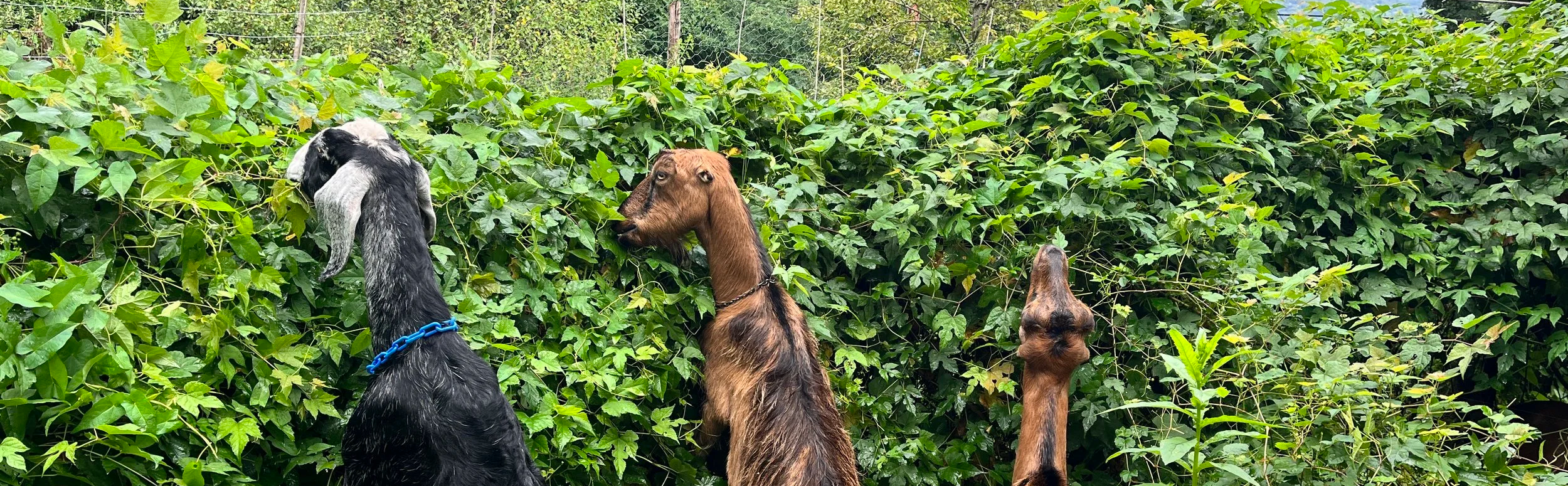
Goats are effective, ecologically-friendly and create social engagement as they work. The herd manages Pittsburgh's steep slopes with ease, and collectively removes thorny, itchy, and invasive plants. They remove vegetation in ways that people and machinery cannot. The goats reduce the need for fuels and herbicides, while adding ready fertilizer to the soils at project sites which are often eroding or undernourished. Goats’ preference for vines and shrubs means that in some instances they climb and stamp down forage. Goats are agile and adaptable to diverse forage. Goats’ four chambered stomaches and digestion processes reduce rates of seed viability, and make it possible for goats to eat so much green and brown plant material. Goats, among other ruminants, like cows and sheep, defoliate plants of their ability to photosynthesize, and overtime may reduce over abundant and invasive vegetation.
-
You can expect one of our herds to eat through one full acre in 10-14 days. This can vary with vegetation type and density, weather, and topography.
-
There are a few plants found in our landscapes that are toxic to goats. Some plants such as snakeroot and milkweed, are common and the goats avoid. Others, such as poison hemlock, yew or azalea, will be removed by AGS staff prior to the goats’ arrival, or completely avoided due to their prevalence and poisonous properties.
-
Goats DO eat poison ivy! Actually, many wild animals eat poison ivy as well, including deer, bears, turkeys, crows and raccoons. Goats have special gut enzymes that break down the oil found on all parts of the plant that cause rashes on humans. The issue is that the goats may get the oils on their coats while eating and when humans touch the goats, they may get it.
-
Except for special events, AGS asks that community members not pet or feed the animals while they’re working. It’s especially important because there are plants in our area, such as yew and poison hemlock, that are highly toxic to goats and donkeys. Trained volunteers have learned proper identification and animal care, and are allowed to be with animals on site. It’s also important not to pet the animals since they regularly eat poison ivy and fresh oils on their mouth or body can easily be transferred to skin.
-
AGS’ miniature donkeys, Sunshine, Hobo, Diamond, and Pete are the guardians of our goats. Donkeys are herd animals just like goats, and serve as protectors of a herd from perceived threats such as coyotes. (They have a natural dislike of canines.) Mini donkeys can eat many of the varied plants that goats eat, though their favorites are grasses. Farms, dairies and homesteads may use donkeys or other pack animals such as llamas, alpacas and dogs to protect goats and other animals.
-
Goats come in all shapes sizes and colors! The breeds represented in our herds include: Nubian, Alpine, Nigerian dwarf, La Mancha, Boer, as well as some crosses. Some goats have beards, while others do not, and it is not related to gender. Some goats grow horns, while others do not. AGS goats, as a rule do not have horns. There are a few who were born to grow horns but they were disbudded soon after birth, inhibiting their growth. We do not have horned goats out of safety for other goats, the fencing we use, and the fact that the City of Pittsburgh does not allow horned goat ownership within City limits.
-
When the weather gets cold and there is no longer any green vegetation in the landscape, the herds are taken to a shelter with room to roam and provided hay, vitamins, minerals, and fresh water. While goats generally able to withstand extreme heat and cold, it is important that they have dry shelter, and are protected from wet winter weather.
-
Although possible, it is entirely unlikely that a goat herd will escape their fenced area on their own accord. If they do escape, it is likely because a deer has run through the fence first and pulled a significant amount down, or the power was accidentally left off (and they know the power is off) and some food proved to be too tempting on the outside of their area. While goats are incredibly inquisitive creatures, they have been trained on the fence and learned quickly that the fence wasn’t worth messing with.
-
We keep our calendar about where the goats are working up to date. Check out our current projects and updated locations here.
-
Thanks for checking! We’re unable to re-home goats at this time, but have connected with some local rescues and sanctuaries that might be able to assist you.
-
Allegheny GoatScape has so many ways you can support us! We accept monetary donations, as well as donations of vehicles or land, or you can show your support by sponsoring an animal, or even just picking up some fun AGS merch in our shop. Check out our Support Us page to learn more.